
Introduction
In the traditional world of content marketing, there was always a painful trade-off: Quality vs. Quantity. You could either write one deep, research-backed article a week, or you could churn out five thin, generic posts that barely moved the needle.
In 2026, Artificial Intelligence has broken that binary. But here is the catch: Most people are doing it wrong.
They are using AI as a "Content Generator" asking ChatGPT to "write a blog post about X" and copying the output. This is a one-way ticket to getting penalized by Google’s core updates.
To scale from 1 to 10 posts a week without triggering spam filters, you don't need a generator; you need an AI Content Engine.
Here is the blueprint for building a production line that marries AI speed with human expertise (E-E-A-T).
Phase 1: The Architecture (Topic Clusters)
Before you generate a single word, you need a map. Randomly publishing 10 posts a week will cannibalize your own keywords.
1. Automate Keyword Clustering
Instead of hunting for keywords one by one, use AI to build Topical Authority.
The Prompt Strategy: Feed an AI tool a list of 50 keywords in your niche. Ask it to group them into "Parent Topics" and "Child Articles."
The Output: You now have a content calendar where every post links naturally to the next. This structure tells Google you are an expert in the entire niche, not just one keyword.
Phase 2: The "Sandwich Method" (The Secret to Quality)
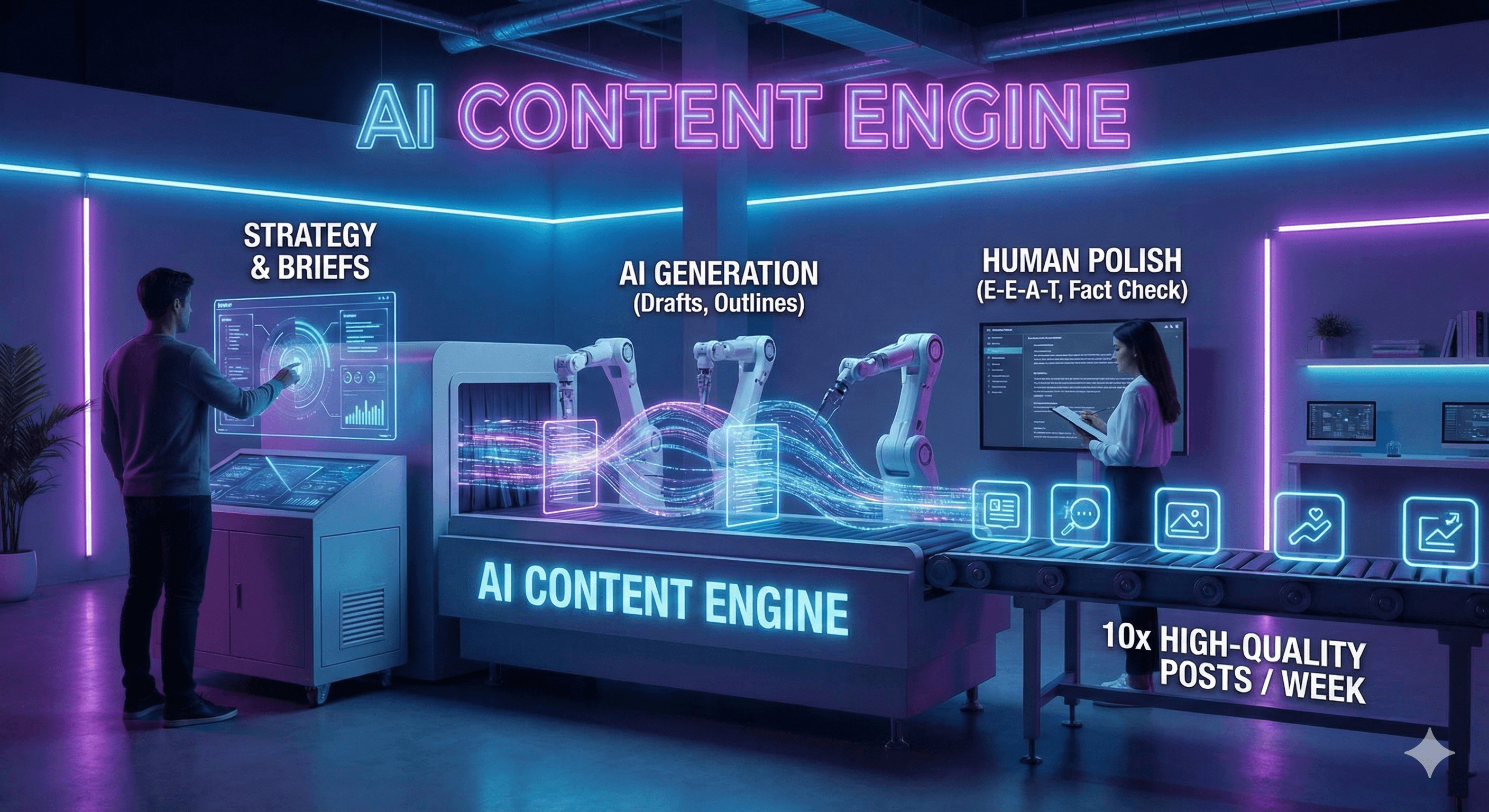
The biggest mistake SEOs make is letting AI handle the entire process. The winning formula is Human - AI - Human.
Layer 1: Human Strategy (The Brief)
AI lacks intent. You must provide the "angle."
Don't just give a keyword.
Give a structured brief: "Target Audience: CTOs of SaaS startups. Tone: Professional but skeptical. Goal: Convince them that manual security audits are risky."
Layer 2: AI Heavy Lifting (The Draft)
This is where you gain speed. Use AI to execute specific tasks, not just "write."
Step A: Generate 5 headline variations (optimize for CTR).
Step B: Create a detailed outline with H2s and H3s based on competitor gaps.
Step C: Draft section by section. Pro Tip: Ask the AI to "include an analogy" or "use bullet points" to break up text walls.
Layer 3: Human Polish (The E-E-A-T Injection)
This is the "un-hackable" part. Google wants Experience, Expertise, Authoritativeness, and Trustworthiness. AI cannot fake experience.
Add Personal Data: "In our case study..."
Insert Opinion: "Unlike the popular belief, I think..."
Fact Check: AI hallucinates. Verify every statistic and quote.
Phase 3: Operationalizing the Workflow
To hit 10 posts a week, you need a manufacturing mindset.
1. Batch Prompting
Don't switch contexts.
Monday: Generate 10 Outlines.
Tuesday: Generate 10 Drafts.
Wednesday: Human Editing & Fact Checking.
Thursday: Visuals & Formatting.
Friday: Scheduling & Distribution.
2. Define Your "Custom Instructions"
If you are using ChatGPT or Gemini, set your "System Prompt" once.
Example: "You are an expert SEO copywriter. You despise fluff. You use short sentences. You never start sentences with 'In the fast-paced world of...'"
This ensures consistency across all 10 posts without re-briefing every time.
Phase 4: Avoiding the "AI Content" Trap
Google doesn't hate AI content; it hates useless content. To ensure your scaled content ranks:
The Information Gain Score: Does your post add something new to the internet, or is it just summarizing the top 3 results? Use AI to find unique angles, not just repeat facts.
Internal Linking at Scale: As you publish 10 posts a week, your internal link graph grows fast. Use AI tools to suggest internal links between your new batch and your old evergreen content immediately.
Conclusion
It’s Not Magic, It’s Management
Scaling from 1 to 10 posts isn't about typing faster. It's about shifting your role from "Writer" to "Editor-in-Chief."
Your AI Content Engine is the printing press, but you are the journalist. Keep the standards high, keep the strategy human, and let the engine handle the grunt work. That is how you dominate the SERPs in the age of generative search.